Gazelli Art House is presenting a solo booth dedicated to pioneering British artist Harold Cohen (1928–2016) at Zero 10’s 2026 Basel edition. Best known as the creator of AARON, one of the earliest autonomous systems for artmaking, Cohen first rose to prominence as a leading post-war painter, representing Great Britain at the 1966 Venice Biennale before turning toward computer-generated art in the late 1960s. Bringing together paintings, drawings, and live-running code systems, the booth offers audiences a rare opportunity to encounter AARON as Cohen intended: not as a historical artefact, but as a living studio collaborator operating in real time.
The presentation traces Cohen’s lifelong investigation into systems, perception, and artistic authorship. From his early painterly abstractions of the 1960s through to the vivid machine-generated compositions of the 1990s and 2000s, the booth situates Cohen not only as a foundational figure in computer art, but as one of the earliest artists to interrogate the relationship between human creativity and algorithmic processes. Decades before AI entered mainstream consciousness, Cohen was already exploring many of the questions that continue to define today’s debates around creativity, agency, and machine intelligence.
Unlike today’s AI creation tools that pull from huge data sets of online images and use complex systems to match a users’ prompts to those images – Cohen wrote his programme to autonomously create art by following rules that mimicked how an artist thinks. AARON works like a robotic artist following a guidebook Cohen wrote in code (using languages like C and later Lisp). This guidebook contains instructions, or “rules,” about how to combine simple shapes (called “primitives,” such as lines and curves) into recognizable objects, like a person or a plant.

When Cohen first created AARON in the late 1960s, it could only draw abstract lines and shapes because those were the only rules it had. By the early 1980s, Cohen added new rules to teach AARON how to draw people. For example, he programmed it with instructions like “a person has a head, two arms, and legs” and “arms bend at the elbow.” Using these, AARON could build a human figure by connecting lines for limbs, adding a head, and placing it realistically in a scene.
Around 1983-1984, Cohen expanded AARON’s guidebook by programming rules for drawing rocks, part of what he called the “rock-art paradigm.” These rules told AARON how to create rock-like shapes and how to place them in a landscape, like at the bottom of a scene to suggest ground. Once these rules were added, AARON could choose to include rocks in its images, just as it could choose people, because its “vocabulary” of possible objects now included both.
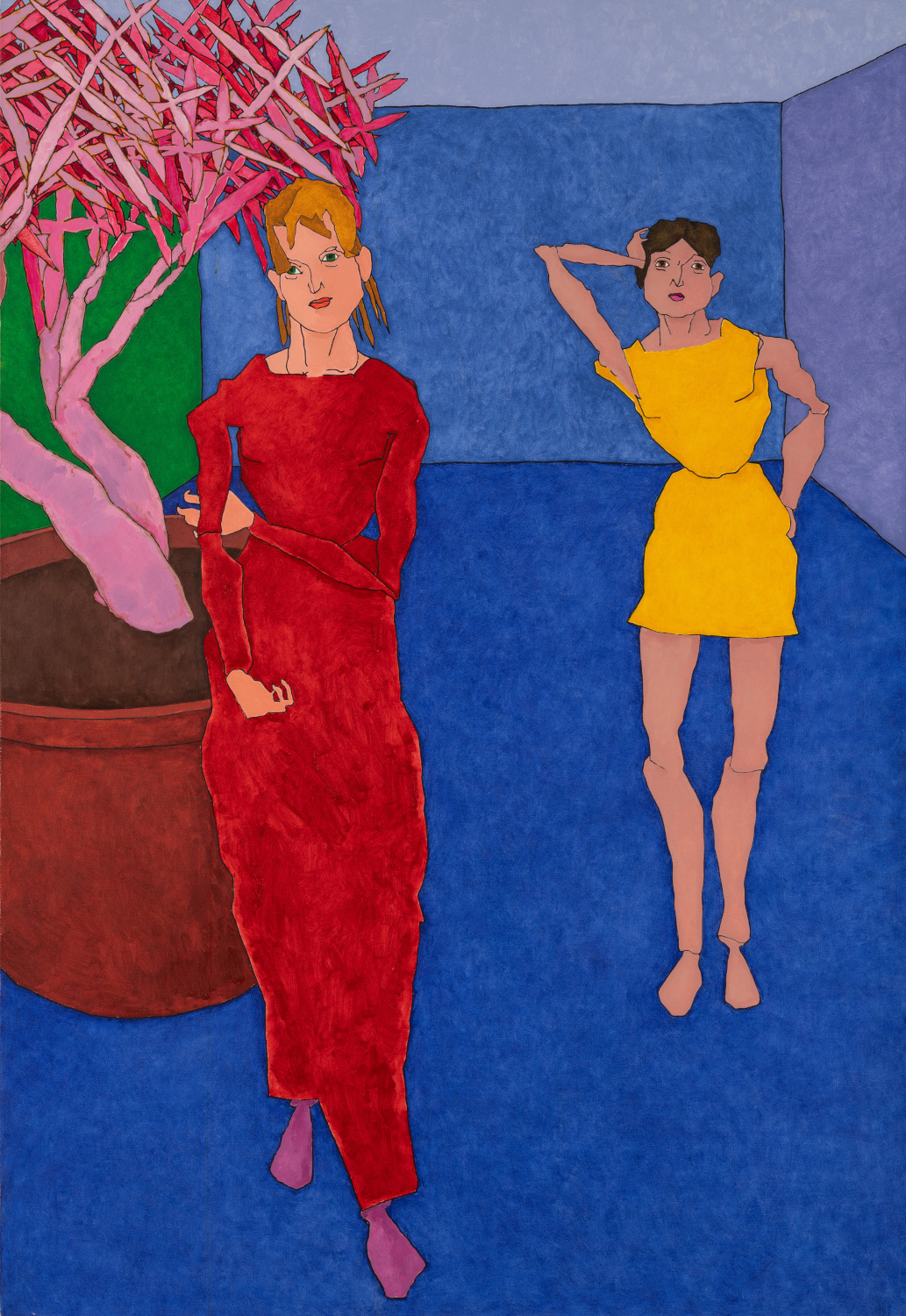
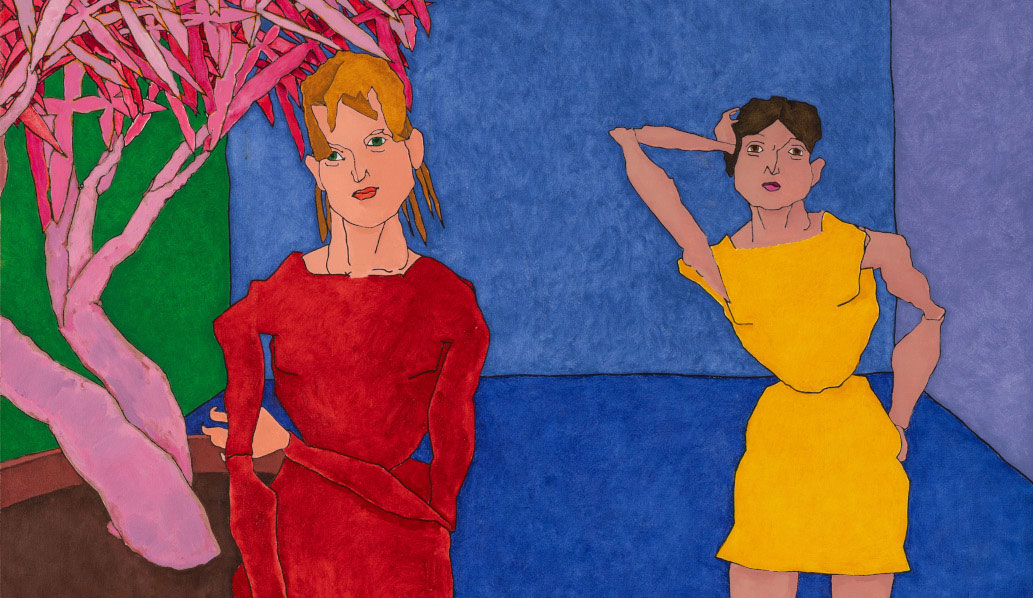
Over time, Cohen kept adding more rules, teaching AARON to draw plants, trees, and even indoor scenes with furniture by the 1990s. Each new set of rules was like giving AARON a new art lesson, expanding what it could draw. When deciding how to compose a piece, AARON follows a process where the number of elements is determined by Cohen’s rules for balance and composition, with some randomness to keep things varied.
AARON starts by dividing the canvas into sections, like the foreground, middleground, and background. Cohen’s rules then guide it to make the scene look balanced – not too crowded or too empty. For example, it might decide the center needs a main object (like a person) and the edges need smaller ones (like rocks or plants).
Once the layout is set, AARON picks what to draw from its “menu” of objects (e.g. people, rocks, plants) based on the rules Cohen gave it. It doesn’t need the artist to prompt it by saying, “Put two people here.” Instead, the rules include ideas about how many objects make sense for the scene’s size and balance. For instance, a rule might say, “If the canvas is large, include 1-3 main objects (like people) and 2-5 smaller ones (like rocks).” After deciding what and how many objects to include, AARON builds them using its primitives (lines, curves) and draws them with a plotter (a pen-moving machine). By the 1990s, it could add colours like green for plants or skin tones for people, following rules for what looks natural.

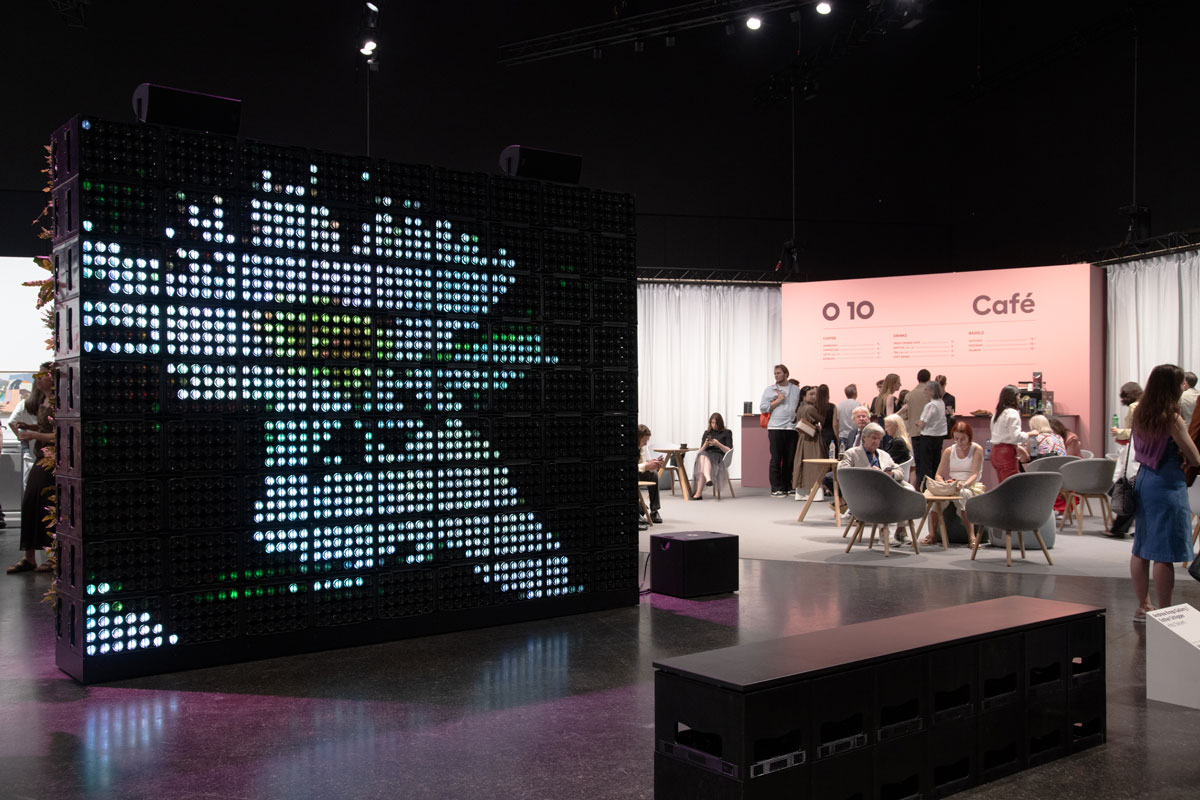
Live-running AARON codes are operating throughout the fair, continuously generating autonomous drawings in real time. These works trace more than three decades of Cohen’s evolving algorithmic thinking, from the early ‘freehand line’ structures of the Maze works through to the increasingly complex compositional and figurative capabilities of AARON’s later years.
The presentation features All Four (1964), a major early abstract painting exhibited in Harold Cohen: Paintings 1960–65 at the Whitechapel Gallery in 1965. Presented alongside his later machine-generated works, All Four highlights the evolution between Cohen’s painterly practice and his later computational systems. Its looping biomorphic forms and visual codification show Cohen’s growing interest in systems, structure, and rule-based image construction years before he began programming computers.
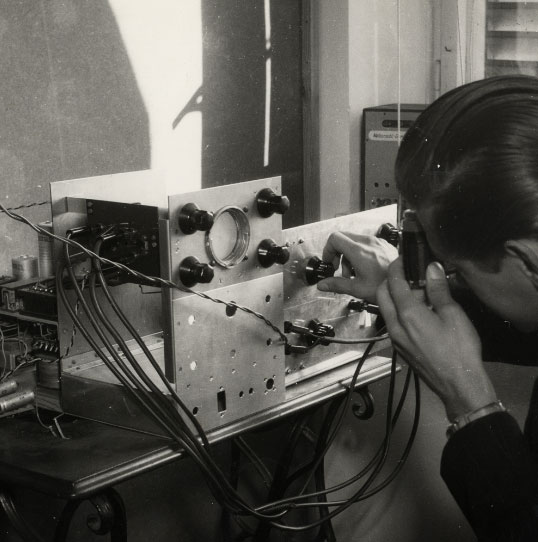
This formative period was shaped by Cohen’s move to the United States in 1968, where he joined the University of California San Diego and began learning to programme. Cohen produced foundational bodies of work such as the Contour Maps, Territorial Maps, and Maze drawings, developing the procedural logic that would later underpin AARON. Rather than instructing the machine what to draw, Cohen became increasingly interested in defining the conditions through which drawings could emerge autonomously. A rare example from this period, Untitled (i23-3578) (1972) belongs to Cohen’s seminal Maze series, produced using his First Generation Drawing Machine and early ‘freehand line’ algorithm. These works marked a pivotal moment in the development of AARON and Cohen’s broader investigations into rule-based artmaking.

A key focus of the presentation is on works from the 1990s, when AARON gained the ability to direct physical color application through custom-built robotic hardware in addition to generating compositions autonomously. In Untitled (i23-3391), geometric architectural forms are combined with bold fields of saturated blue, crimson, and yellow showing AARON’s development of more complex relationships between figure, space, and color.
Machine Painting Series TCM #19 (1997) then demonstrates a further stage in this development where AARON not only generated the composition and color structure but also directed the custom-built Painting Machine to apply dyes onto paper without direct human intervention. Together, these works mark a pivotal moment in the evolution of computer-generated art.
“Creativity – this particular example of creativity – lay in neither the programmer alone nor in the program alone, but in the dialog between program and programmer; a dialog resting upon the special and peculiarly intimate relationship that had grown up between us over the years.”
– Harold Cohen, Driving the Creative Machine (2010)