Web3 builder conferences are not designed for art.
They are structured around acceleration: hackathons, protocol upgrades, token design, governance frameworks. Attention moves quickly. Culture and art often become backdrops.
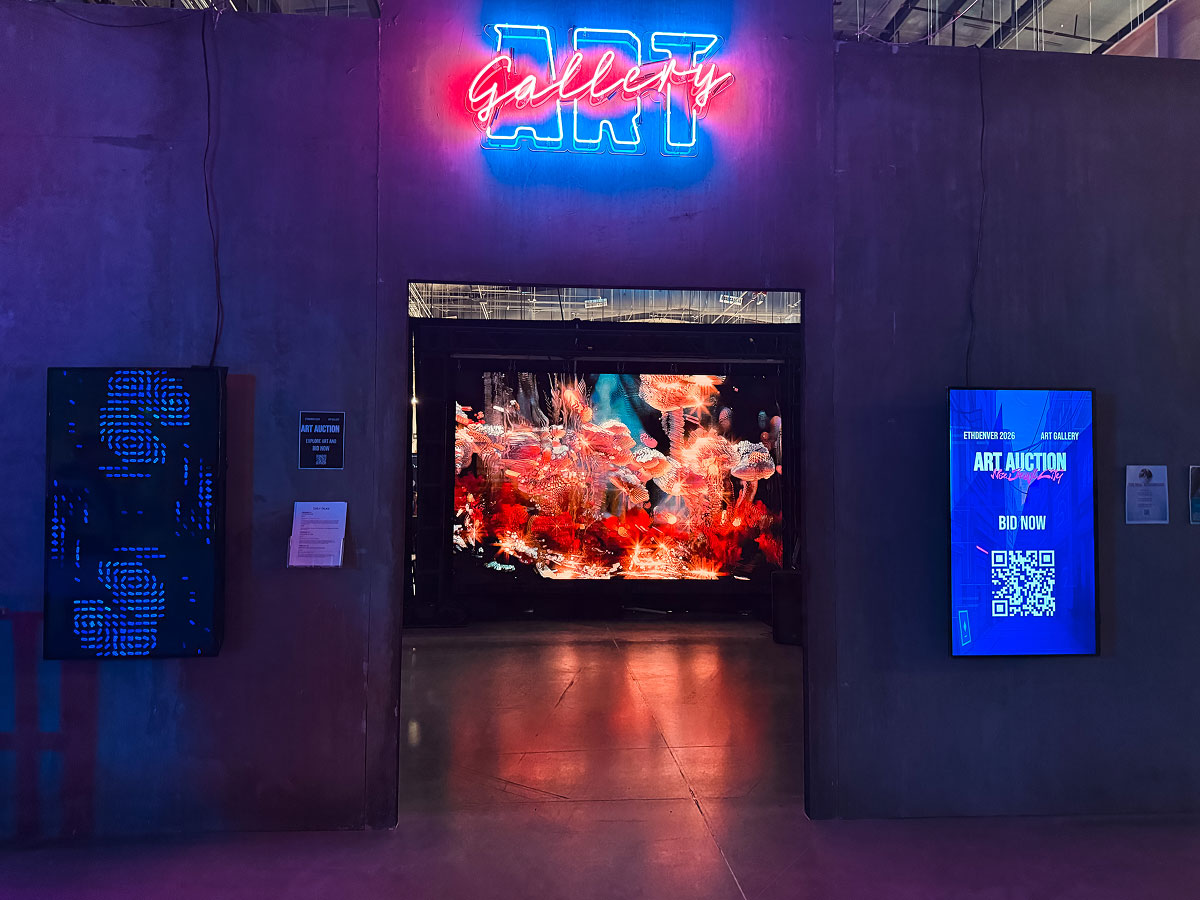
Held in February 2026 in Denver, Colorado, ETHDenver once again gathered developers, founders, and participants across the Ethereum ecosystem inside one of the largest blockchain-focused events in the world. Within that environment, the art gallery offered something more demanding than decoration. Curated by Elena Zavelev, it operated as a case study in how cultural infrastructure can function inside a builder ecosystem rather than outside it.
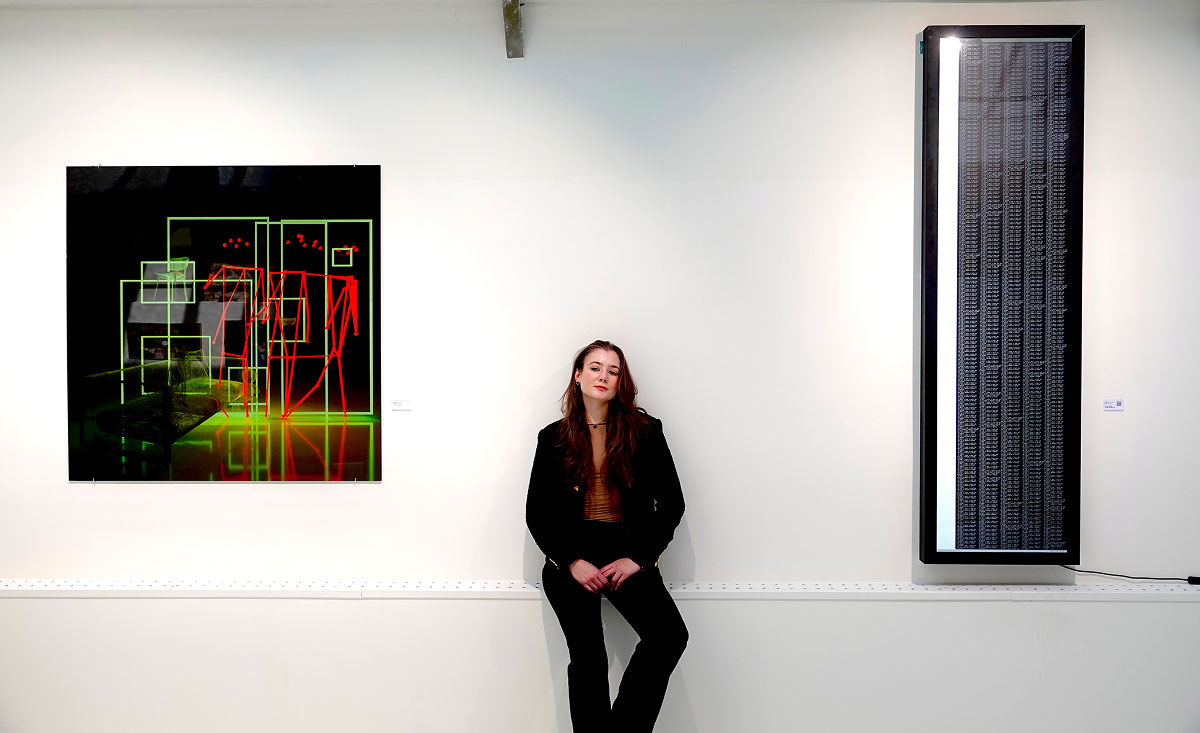
Instead of positioning art as a counterweight to the technical environment, the gallery adopted a similar structural logic: distributed, layered, collaborative. Collector-led presentations, emerging and established digital artists, generative practices, foundational blockchain-era works, and augmented reality interventions operated in deliberate adjacency.
“The question wasn’t how to show digital art,” Zavelev notes. “It was how to structure it so it functions within the ecosystem it’s part of.”
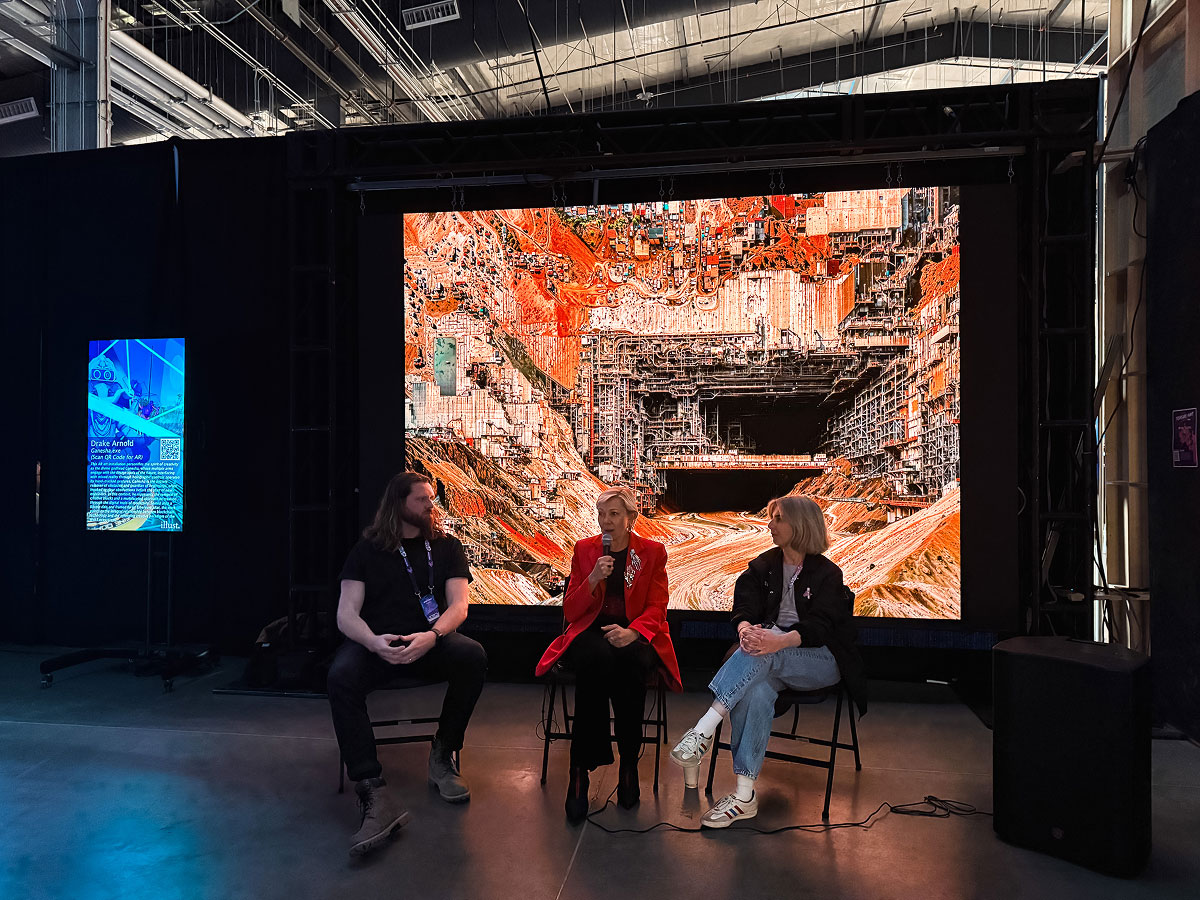
That emphasis on structure defined the exhibition.
A central pillar was the international open call hosted with HUG.art. Selected artists – including MadamMemoticon, Pardesco, ZenMatAI, Drake Arnold, Planttdaddii, Gala Mirissa, Jaen, Melissa DiVietri, Simone Behrsing, Zenshortz, BigTrav, Bustos, Paradigm Stories, Cromwell, Heather Timm, Moonzoey, Granada, Anna Kevrel, Alfonso De Orte, Visheh, Wildy Martinez, Unni Krishna, Yulia Kosyak, Archana Aneja, Ah Choe, Ponpop Cynn, Jamstar, ItsZuzah, Krookid Hooks, and Robby Oso — were embedded throughout the exhibition. There was no “emerging” zone.
Augmented reality, activated by Illust.Space, extended this layered approach. Works by ZenMaterialist, Pardesco, Bryan Brinkman, Coldie, APØCALYPSE, Drake Arnold, Clara Bacou, and MF DOOM appeared as spatial overlays within the installation. AR did not function as spectacle. It operated as a secondary architectural layer – expanding spatial logic rather than distracting from it.
The exhibition also mapped Ethereum’s artistic timeline.
Kate Vass presented foundational blockchain-era works by Alexander Mordvintsev, Beeple, Casey Reas, Daniel Calderon Arenas, David Young, Dmitri Cherniak, Elman Mansimov, Gene Kogan, Helena Sarin, Iness Rychlik, Isa Rus, Larva Labs, Manoloide, Mario Klingemann, MCSK, Operator, Sam Spratt, Snowfro, XCOPY, and 0xDEAFBEEF. These works underscored how artistic infrastructure developed alongside protocol infrastructure – through experimentation, peer networks, and long-term collector stewardship.
The 100 Collectors section, drawing from the collections of zaphodok, dagiedee, Danielle King, Diane Drubay, EDOUARD, Jean-Michel Pailhon, Mathias Thiel, and Fanny Lakoubay, emphasised continuity over cycles. A timeline marked sustained collecting since 2018 and highlighted artists such as Waffles, whose fluid on-chain identity complicates traditional visibility and authorship. In this context, collecting becomes less about acquisition and more about ecosystem maintenance.
Olena Yara introduced works by Lindsay Kokoshka, whose painterly abstraction carried psychological density into tokenised form, expanding the aesthetic vocabulary beyond crypto-native minimalism.
Farrah Carbonell’s PRESENCE for ART&VAULT at ETHDenver examined how artworks hold attention across time, scale, and proximity within fast-moving environments. Featuring works by Alkan Avcıoğlu, Edward Burtynsky & Alkan Avcıoğlu, Victoria West, Violet Bond, and Bruna Rotunno, the presentation brought together bodies, landscapes, and systems, allowing meaning to emerge through sustained attention rather than explanation.
DADA.art, represented by Judy Mam, contributed DADA Grammar by Beatriz Ramos and Otro Captore. Founded in 2014, DADA’s visual conversation model reframes decentralisation as lived cultural practice – authorship distributed, dialogue prioritised, individual voice preserved within collective form.
Masako Shiba’s In Praise of Nature: Generative Ecology, featuring Sputniko!, Saeko Ehara, Yoshi Sodeoka, Axl Le Yi, and nouseskou, introduced a systems-oriented lens. Algorithmic processes were positioned as perceptual tools rather than optimisation engines – a quiet but pointed contrast inside a builder environment driven by efficiency and iteration.
Raina Marie presented the video works of Anne Spalter, including Magic Tortoise Island, Vortex Clouds, Pink Skies, Lunar Desert Adventures, and Black Cat Desert Nightwalk. Created with Midjourney, Grok, Krea, Topaz Studio, and Adobe After Effects, the works treated AI as compositional collaborator rather than productivity tool, restoring ambiguity to systems often framed as purely instrumental.
Nadia Taiga contributed works associated with OG.Art and Snark.art, platforms that shaped earlier waves of blockchain experimentation. Their inclusion reinforced that today’s Web3 ecosystem did not emerge fully formed; it is layered over prior cycles of artistic and technical inquiry.
ARSNL.art presented physical works from Frank Stella’s Geometries, connecting modernist structural abstraction to contemporary generative logic. Nouns – the decentralised, community-owned NFT project – also appeared in physical form, bringing on-chain identity into material space.
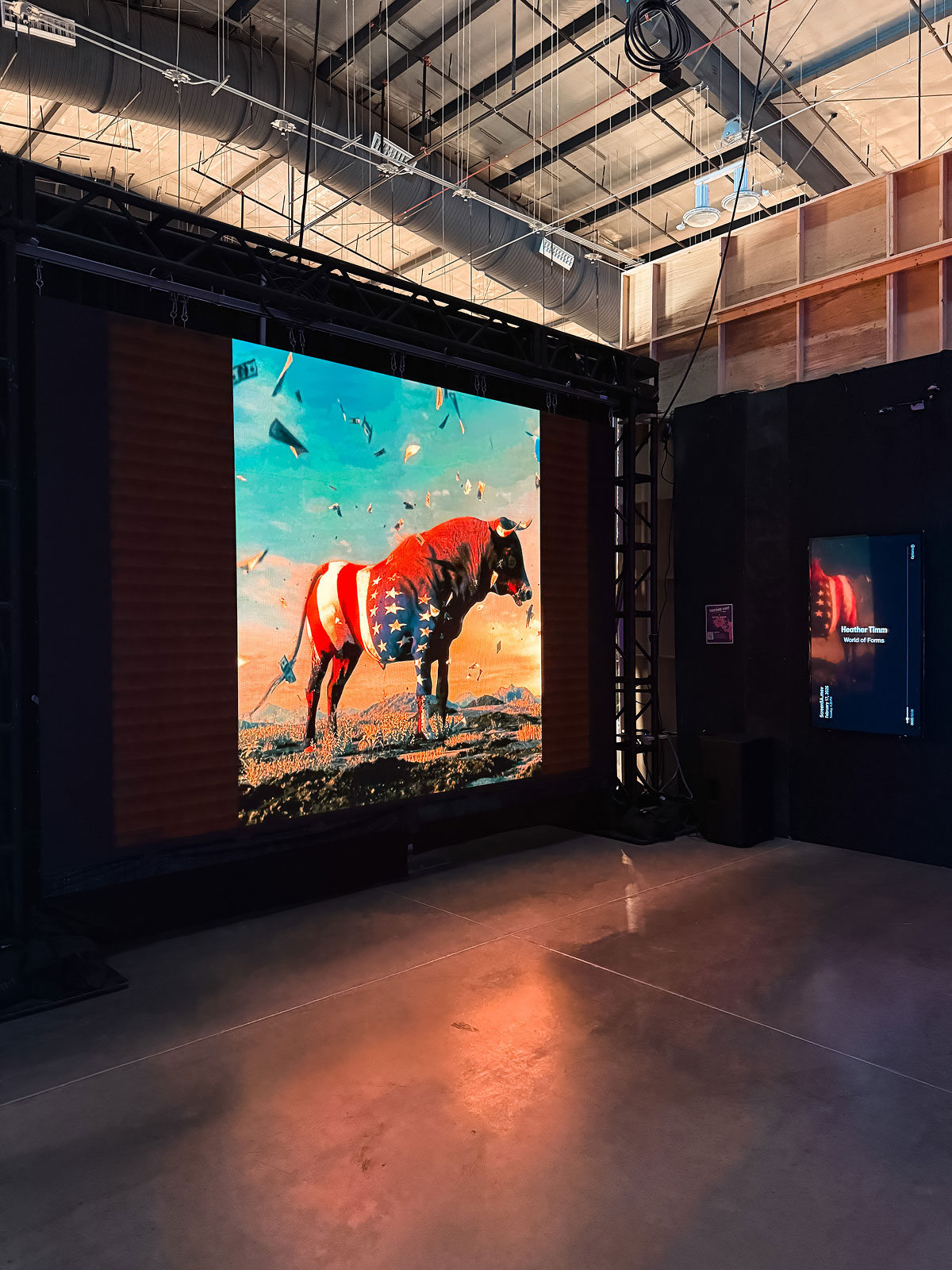
The gallery extended into public dialogue. Talks brought together curators, collectors, artists, and builders to examine community, AI’s evolving role in art practice, and the responsibilities of curation in open systems.
The exhibition offered a working example of how culture can live inside a builder ecosystem.
It showed that art does not slow down a system built for speed. It deepens it.
At ETHDenver, the gallery made something clear: culture is not an accessory to innovation. It is part of what makes innovation human.